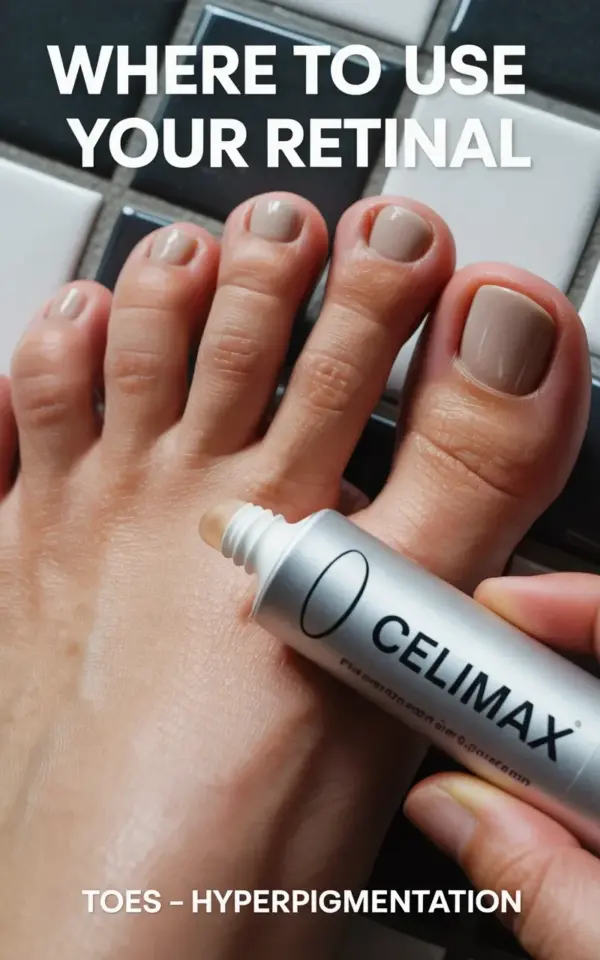
That photo of a foot with neatly painted beige toes and a silver Celimax tube hovering over one nail? That was the exact image that sent me down a two-month skincare rabbit hole. I stared at it on my phone, checked the tile pattern behind the foot, read the words “toes – hyperpigmentation” at the bottom, and thought, absolutely not. Then I looked at my own toes, which have developed these dark, almost bruise-like patches on the knuckles from years of squeezing into pointy flats. Retinal for toe hyperpigmentation is honestly a budget hack, and I say that now after seeing it work with my own eyes. It feels ridiculous to type, but the results are right there on my feet.
Why Your Toe Knuckles Look Dark (And Why You Never Noticed Before)
Ok so, the skin on your feet is thicker than the skin on your face. It has to be, because it carries your entire body weight and gets shoved into socks and shoes all day. That thickness means it sheds slower, and any pigment that forms, whether from friction, sun exposure, or old injuries, just sits there and builds up. The creases over your toe joints are prime spots for this because they are constantly bending and rubbing against the inside of your shoes.
You probably have this and never realized it. I didn’t either, until that viral photo made me sit on the bathroom floor and inspect my feet like a dermatologist about to publish a case study. The hyperpigmentation on the knuckles is not dirt, I know because I scrubbed mine until they were raw. It is pigment, and it needs a chemical exfoliant to break it up.
Retinal vs. Retinol: What You Actually Need For Stubborn Toe Marks
Here is the thing: I tried retinol first. My face retinol, the gentle stuff, the kind that promises a glow without peeling. It did absolutely nothing for my toe marks after four weeks. Then I switched to retinal, which is one step closer in the conversion chain. Retinaldehyde, if we are being fancy, is more potent than retinol but less irritating than prescription tretinoin. It works faster because it only needs one enzymatic step to become retinoic acid in the skin.
For the soles and toe creases, you need that added strength. The skin there is so resilient that a light retinol just bounces off it. I use the Celimax retinal serum, the exact one from that photo, because it is reasonably priced, around twenty dollars, and it layers well under a heavy foot cream. You do not need a prescription product for this. You need the over-the-counter middle child that actually pulls its weight.
A Step-By-Step Guide To Applying Retinal On Your Toes
Let me walk you through what I actually do, because this is not the same as skincare for your face. I wash my feet with a gentle soap and dry them completely. Like, completely. Any lingering moisture between the toes dilutes the formula and makes it less predictable. I squeeze out a tiny pea-sized amount of the retinal serum, which is barely anything, and I dot it directly onto the hyperpigmented knuckle areas.
Then I do the massage thing. I rub it in with a circular motion for about fifteen seconds per toe, just until the serum disappears. The trick is to not apply it to the spaces between the toes, that serves no purpose and can cause irritation in the webbing. Here is the step everyone skips: I wait five full minutes. You have to let the retinal sink in before you lock it with a moisturizer, or you just dilute it.
- Apply only to the knuckle creases, not the whole toe
- Wait five minutes before adding any occlusive cream
- Do this at night, never in the morning before sandals
- Skip a night if your feet feel hot or stingy
That last one is important. Listen, I have a high pain tolerance, but one night I got cocky and applied retinal two nights in a row. My toes were warm and sensitive for a full day. The skin on your feet can tolerate a lot, but it still hates being over-exfoliated. Pace yourself like you are training for a race, not sprinting.
How Long Until Toe Hyperpigmentation Starts To Fade
Honestly, I expected this to be a months-long project. I gave myself a mental deadline of twelve weeks before I would even look for changes. The reality surprised me. Around the three-week mark, I was sitting on the couch and I caught my foot in the light, the kind of golden afternoon light that shows every texture. The dark patches on my big toe joint looked patchy, not solid. They were breaking apart into smaller, lighter sections.
By week six, the improvement was undeniable. The pigment had faded by maybe forty percent, which is not a dramatic transformation, but it was enough that I stopped being embarrassed to wear open-toed shoes. My nails are still painted that same light beige color, by the way. The contrast between the pale polish and the fading brown patches is becoming less obvious every week. I wish I had taken a before photo, but honestly, who documents their toe knuckles? That feels like a weird personality trait.
Full clearance is still in progress. I think total removal is going to take around four or five months of consistent application. But the trajectory is clear, and for the price of one fancy coffee shop lunch, I am getting visible results.
What Nobody Tells You About Using Face Products On Your Feet
There is a weird mental barrier to this. You are trained to think of facial serums as expensive, precious liquids that you ration out in tiny drops. Applying them to your feet feels almost wasteful, like using champagne to wash a car. But here is the reality: a single serum tube lasts me forever because the foot dosage is small. One pea-sized amount covers both big toe knuckles and the sides of my feet.
Another thing nobody mentions is the texture. Retinal can pill, which means it balls up into little flakes if you rub it too much. On your face, this is embarrassing if someone looks close. On your feet, it just gets stuck in the seams of your socks. Wait for it to dry fully, or just go to bed barefoot. I apply mine right before I get into bed, let my feet air out for ten minutes, and then put on some soft cotton socks.
And one more honest warning: the first application stings a little. Not a bad sting, more like a weird sensation, kind of like when you put a cold metal spoon on a sunburn. That passes within a few minutes. If it lasts longer than that, you used too much.
Combining Retinal With Other Treatments For Faster Results
I am not a minimalist when it comes to this specific problem. I want maximum effect for minimal effort. So while the retinal does the heavy lifting at night, I have added a simple morning step: a vitamin C serum, the cheap one from the drugstore, not a fancy vitamin. It makes my toes look brighter, and there is a chance it helps the retinal work better. The science is unclear, but my personal foot evidence likes it.
The other thing that helps is physical exfoliation with a pumice stone once a week. The retinal loosens the pigmented cells from below, but a gentle scrub removes the dead surface layer that is ready to flake off anyway. I know this sounds like a lot of work for feet, and you are probably thinking, who has time for a whole foot-care ritual? But the whole routine takes four minutes a night. Less time than you spend scrolling through your phone looking at other people’s feet.
Sun exposure makes everything worse. I wear sandals all summer, and I am aware that sunscreen on my feet feels gross, slippery, and sandy. But I have started putting a light layer on the top of my feet when I know I will be outside for more than an hour. The less UV damage you accrue, the clearer the results from the retinal. Protect your investment.
Budget Skincare Hacks That Actually Make Sense
This whole experiment taught me that you do not need a separate product for every body part. You need one good active ingredient and the willingness to use it in unintuitive places. I am now the person who uses her acid toner on rough elbows and her retinal on toe knuckles. It feels clever, but maybe it is just common sense dressed up in a serum bottle.
People spend so much money on fancy foot peels and scrubs and masks. The retail price of a foot peel is usually higher than a basic retinal serum, and the results are temporary. This is a more sustainable approach. You are not sloughing off skin in dramatic sheets; you are slowly, boringly, patiently telling your pigment cells to calm down. That is the budget hack. Repurposing your existing products and applying them with intention.
Look, no one is going to stop you on the street to compliment your toe knuckles. But when you are sitting by a pool and you catch a reflection of your feet, and you notice the patches seem lighter than last month, there is a small, quiet satisfaction. It is a hack that works because you are not spending extra money, just changing your perspective.
Anyway, that is my story. I saw a weird photo with text overlay and tile flooring and decided to try something ridiculous. Two months later, I am here to tell you that ridiculous things work. Give it a shot, and be patient with your toes. They have been carrying you around your whole life, so they deserve a little chemical exfoliation.
Leave a Comment