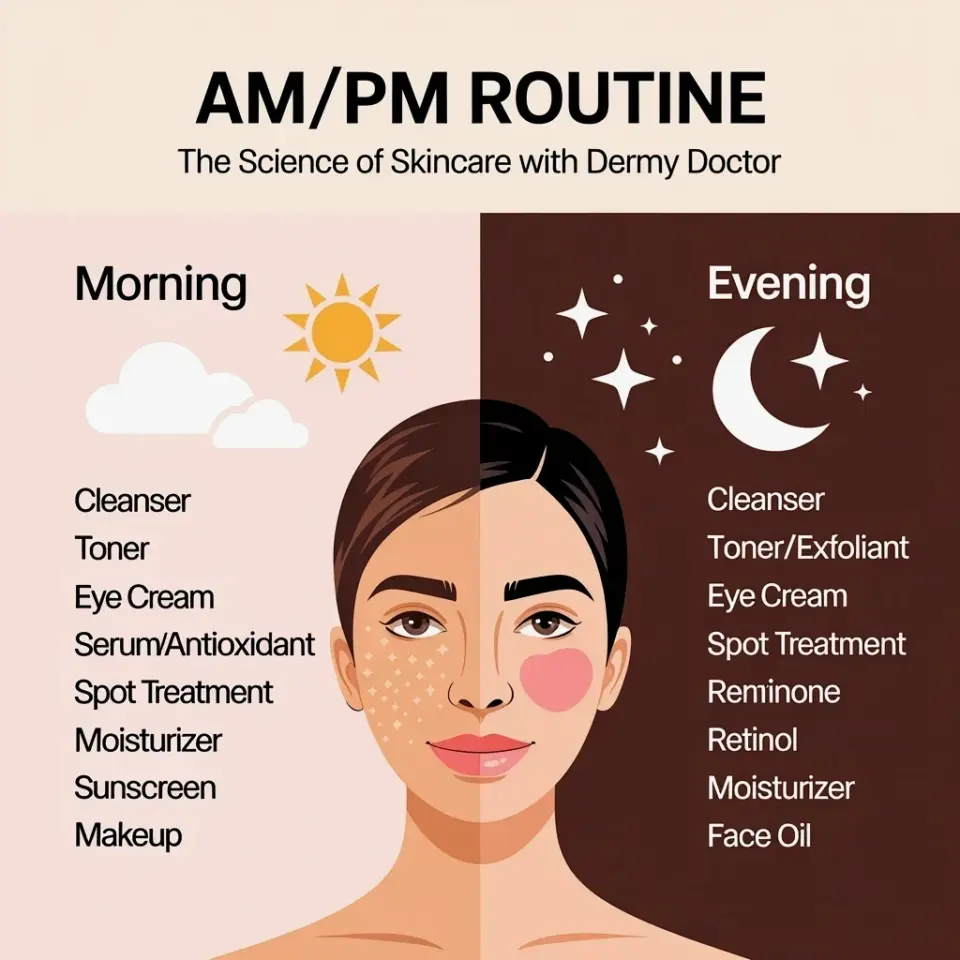
The first thing I noticed about that split infographic, the one with the light pink morning side and the dark brown evening side, is how clean it looks. My own bathroom shelf is a chaotic graveyard of half-used bottles, which is exactly why that visual of a simple split routine stopped me mid-scroll. Most AM/PM skincare routine mistakes happen because we treat our skin the same at 7 a.m. and 10 p.m., and honestly, my skin paid the price for years before I figured out the difference. If you have sensitive skin like mine, learning the science of morning vs evening care is the single fastest way to stop the redness, the weird texture, and the frustration.
The Core Problem: Why Your Morning and Evening Routines Should Not Match
Look, I used to cleanse with the same foaming wash, slap on the same serum, and finish with the same moisturizer, twice a day, every day. I figured consistency was the holy grail. But here’s the thing I learned the hard way: your skin runs on a circadian rhythm, just like your brain does.
During the day, your skin is in defense mode. It is fighting UV rays, pollution, wind, and the general grime of existence. At night, it switches into repair mode, working overtime to rebuild collagen and heal damage. If you give it the same products for both jobs, you are essentially sending a construction crew to do the work of a security team. Your day cream has antioxidants and SPF, which are useless while you sleep, and your night cream is often too rich and occlusive to wear under makeup.
A Quick Lesson in Skin Science for the Sensitive Types
If you have reactive skin, this split matters even more. Your barrier is likely already compromised, which means it can’t handle the stress of doing two jobs at once. The morning needs lightweight, water-based hydration and a robust SPF to protect you. The evening needs ceramides, peptides, and possibly a gentle active to support repair.
I remember asking a derm about this once, and she used a weird analogy that stuck with me. She said the morning routine is like putting on a raincoat before leaving the house, and the evening routine is like taking a shower and changing into pajamas. It sounds goofy, but it perfectly explained why my skin was always tight and flaky. I was wearing a raincoat to bed, essentially, and suffocating my pores.
Morning Mistakes That Wreck Your Barrier by Noon
Morning skincare is less about the products you use and more about the order and the restraint you show. The biggest oops in the AM is skipping SPF because it feels heavy, but those antioxidant serums you spent money on are basically useless if you don’t shield them from the sun.
Another mistake? Over-washing. If you wash your face with a foaming cleanser in the morning, you are stripping away the natural lipids that your skin produced overnight. For a sensitive skin routine, do this instead:
- Just rinse with lukewarm water in the morning if you have dry skin
- Or, use a non-foaming, milky cleanser if you are oily
- Then go straight for a vitamin C serum or niacinamide, but never both if you are just starting out
Here’s a little tangent that might save you money: I used to apply toner in the morning out of habit, but many toners are pH-adjusting and intended for exfoliation. Applying them in the morning before sunscreen just increases irritation. I stopped using toner entirely in the AM, and my redness calmed down within two weeks. That was the weird, specific moment I became a believer in the split system.
Evening Routine Errors That Sabotage Your Skin While You Sleep
The evening is where you get to do the heavy lifting, but there is a catch. The most common evening mistake is going to bed without washing off the day, which I am absolutely guilty of when I am tired. But the second most common mistake is over-cleansing, like doing a double cleanse when you only wore moisturizer and no makeup. That classic oil-based and water-based double cleanse is great for heavy sunscreen, but for a low-maintenance evening, it is overkill and can break down your barrier.
Nighttime is also when people tend to over-layer actives. I see these routines online with retinol, acids, and peptides all stacked together. If you do this on sensitive skin, you are inviting peeling, breakouts, and a compromised barrier. Choose one heavy hitter, apply it on dry skin, and let it sink in. Do not bathe your face in a cocktail of ingredients.
How to Read Your Skin and Adjust the Simple Split Guide
Ok so, after a few months of following the proper split routine, I learned that rigidity is also a mistake. My skin changes with the seasons, my stress levels, and even my hydration status. The infographic with the sun and the crescent moon is a great baseline, but it is not a law carved in stone.
If your skin feels tight after cleansing in the morning, skip the cleanser entirely for a few days. If your night cream feels greasy, you might not need the heavy one every day. Think of the morning-evening routine as a dial, not a switch. Learning to listen to your skin is the actual science of skincare, the graphics just help you get started.
My Final Checklist for a Calm, Simplified Split Routine
Here is the brutally simplified version of what I actually do now. It took me two years to whittle it down to this, and my sensitive skin has never looked calmer. I keep this checklist in my notes app, and I follow it even when I am exhausted.
- Morning: water rinse (or milky cleanser), niacinamide serum, light moisturizer, SPF 50
- Evening: gentle cleanser, a pea-sized amount of retinol (three times a week only), rich moisturizer
- Off nights: swap retinol for a barrier-repair cream with ceramides
The weird part is that my skin got better when I stopped doing so much. I used to think a comprehensive routine meant 10 steps, but it actually means the right two or three steps at the right time of day. Anyway, that is my experience with the split method, and I will never go back to the one-bottle-fits-all approach. Save that infographic, save this checklist, and give your skin the break it deserves. Your face will literally thank you by being less angry.
Leave a Comment